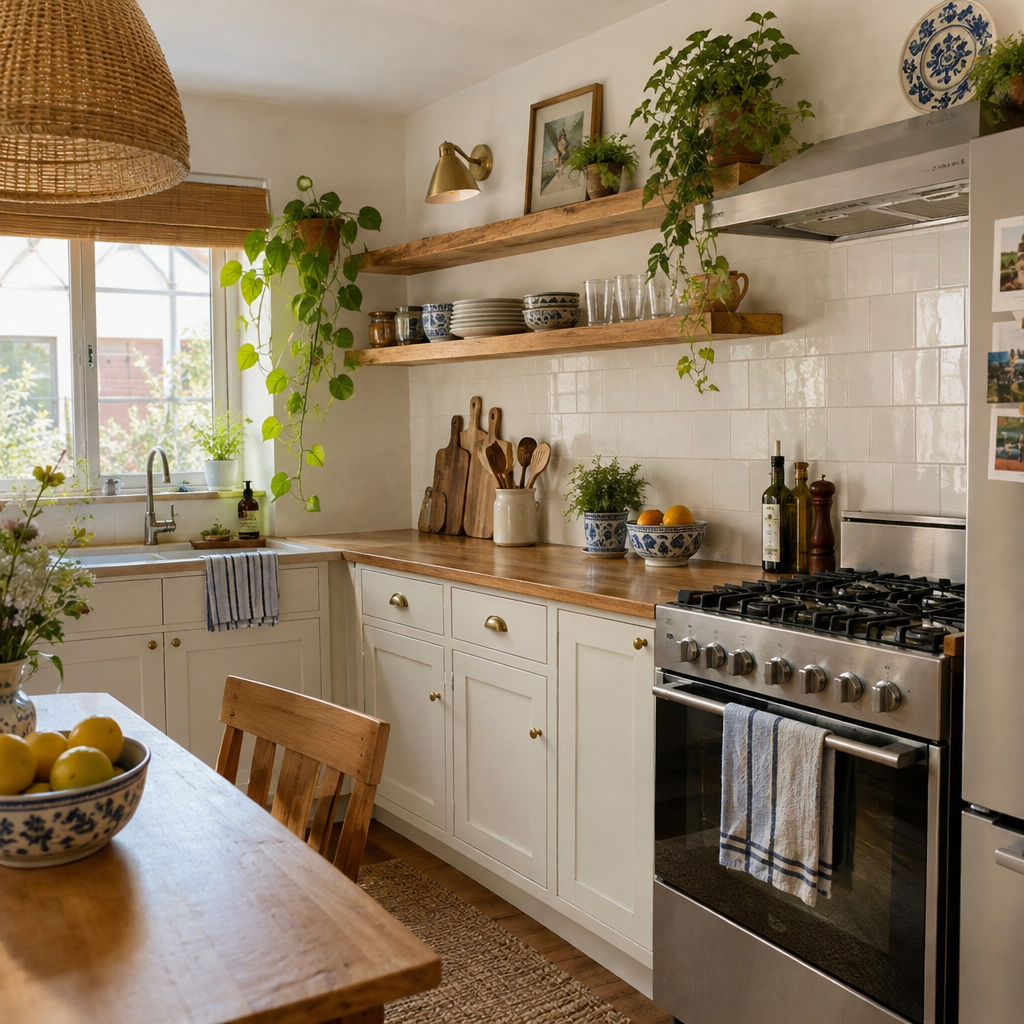
A favourite jacket can make an ordinary outfit feel like yours. A room has its equivalents: the armchair you always choose, a bowl brought home from a journey, the faded stripe on a cushion that has survived three different sofas. Start a decorating scheme with one of those pieces and you already have something a catalogue cannot supply: a point of view.
The next step is to give that piece good company. Colour, furniture and textiles work best when you build them into the routines of a real home, leaving room for the useful and the slightly unexpected.
Choose your background, then try the accents
Set your starting object beside the materials already in the room. The floor, the curtains and the largest upholstered piece will influence the scheme more than a row of small accessories. If you enjoy warm neutrals, compare shades of oat, stone and soft grey beside those fixed surfaces. A neutral is still a colour; its undertone can become surprisingly obvious next to another one.
Now try an accent drawn from your object. A mustard cushion might pick up a detail in a print; a deep green lamp could echo a glazed bowl. Move the sample around in daylight and with your evening lights on. Look for a relationship you like rather than a perfect match.
As with getting dressed, adding every good idea at once can make the result harder to read. Put a few options away, live with the room, and bring back the one you miss.
Fit the furniture to the habits
Imagine a friend arriving with a coat and a glass in hand. Is there somewhere to put both? Can you sit facing each other without one person perching awkwardly? These small questions reveal more about a layout than a photograph of an empty room.
Measure furniture before you buy, including the space it needs in use. A chair pulls back; a cabinet door swings; the useful storage beneath an ottoman needs to be reachable. Mark footprints on the floor and walk through them before committing to a new piece.
Try moving an existing chair toward the window or turning the seating toward a view. Sometimes the room already owns what it needs, just in the wrong places.
Let fabric bring the different surfaces together
Think about the hand of a fabric as well as its colour. A crisp cotton cover, a slubby weave and a soft wool throw can share a palette while offering different sensations. Put the textiles where you will touch them, not simply where they complete a photograph.
Linen has a much longer history than today’s pale interiors suggest. The Metropolitan Museum of Art holds a finely woven linen sheet dated about 1491–1473 BCE. Looking closely at that surviving cloth is a reminder to notice the skill of weaving, not just the fashionable name of a fibre.
For curtains, decide what the window needs to do: soften glare, provide privacy or darken a bedroom. Check how the fabric hangs and how you will clean it. A beautiful material becomes an expensive irritation if it cannot do the job.
Keep the objects that make you pause
Place a photograph where you can actually see it from your seat. Give a treasured object a clear patch of shelf rather than surrounding it with things bought to fill gaps. A reading corner needs a comfortable chair, useful light and somewhere for the book; it can acquire the rest slowly.
Add planting only where the light and your care routine suit it. Keep the leaves clear of the route through the room, and make watering easy enough that you will do it.
At the end of the evening, look around from your usual place. If the room feels comfortable and a few things catch your eye for good reasons, stop arranging. More ideas can wait in the decoration journal until you need them.